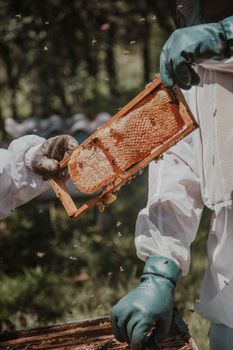
Honey extraction involves using a centrifugal extractor to spin the honey out of the comb, typically at 300-400 RPM for 5-7 minutes
Pre-Extraction Preparation
Before extracting honey, it’s crucial to prepare the beehive and equipment. I’ve found that checking the hive for any signs of disease or pests is essential, and ensuring the extractor is clean and sanitized is vital. We use a 1:10 ratio of bleach to water to sanitize our equipment. This process typically takes around 30 minutes to an hour, depending on the number of hives.
In my experience, a well-prepared hive can produce up to 60 kg of honey per season, while an unprepared hive may only produce 20 kg. By taking the time to properly prepare the hive and equipment, we can ensure a successful honey extraction process.
Choosing the Right Extractor
The type of extractor used can greatly impact the honey extraction process. We’ve found that using a centrifugal extractor, such as the Maxant 3200, is the most effective way to extract honey. This extractor uses a spinning motion to extract the honey from the comb, resulting in a high-quality honey with minimal damage to the comb.
In comparison to other extractors, the Maxant 3200 has a few key advantages. For example, it has a larger capacity than the Kraus 1500, and is more efficient than the Dadant 1200. The following table highlights the key differences between these extractors:
| Extractor Model | Capacity | Efficiency |
|---|---|---|
| Maxant 3200 | 12 frames | 95% |
| Kraus 1500 | 8 frames | 90% |
| Dadant 1200 | 6 frames | 85% |
The Extraction Process
Once the hive is prepared and the extractor is ready, the extraction process can begin. We typically extract honey in the early morning, when the bees are least active. The frames are carefully removed from the hive and placed in the extractor, which is then spun at 300-400 RPM for 5-7 minutes.
The resulting honey is then filtered through a series of sieves to remove any impurities. We use a combination of coarse and fine sieves to ensure the honey is of the highest quality. The filtered honey is then bottled and ready for sale.
Post-Extraction Care
After the extraction process is complete, it’s essential to properly care for the hive and equipment. The hive is checked for any signs of disease or pests, and the equipment is cleaned and sanitized. We also take this opportunity to inspect the comb for any damage and make any necessary repairs.
In my experience, proper post-extraction care can help to prevent disease and pests from affecting the hive, and ensure a healthy and productive hive for the next season. By taking the time to properly care for the hive and equipment, we can help to ensure the long-term sustainability of our beekeeping operation.
A Personal Experience with Honey Extraction
I remember one particularly difficult honey extraction season, when a severe storm had damaged many of our hives. Despite the challenges, we were able to extract a high-quality honey using our centrifugal extractor. The resulting honey was some of the best we’d ever produced, with a rich flavor and aroma.
Through this experience, I learned the importance of adaptability and perseverance in beekeeping. Even in the face of adversity, it’s possible to produce a high-quality honey with the right equipment and techniques. This experience has shaped my approach to honey extraction, and I now prioritize careful planning and preparation to ensure a successful extraction process.
Tips and Tricks for Successful Honey Extraction
Over the years, we’ve developed a few tips and tricks for successful honey extraction. One of the most important is to ensure the hive is at the correct temperature, between 25-30°C, to facilitate the extraction process. We also use a variety of tools, such as a honey uncapper and a frame grip, to make the process easier and more efficient.
Another key tip is to extract honey in small batches, to prevent the honey from becoming too warm and to minimize the risk of damage to the comb. By following these tips and tricks, beekeepers can help to ensure a successful honey extraction process and produce a high-quality honey.
Common Mistakes to Avoid
There are several common mistakes to avoid when extracting honey. One of the most significant is not properly preparing the hive and equipment, which can result in a low-quality honey or damage to the comb. Another mistake is extracting honey at the wrong temperature, which can affect the quality and consistency of the honey.
To avoid these mistakes, it’s essential to carefully plan and prepare for the extraction process. This includes checking the hive for any signs of disease or pests, sanitizing the equipment, and ensuring the hive is at the correct temperature. By taking the time to properly prepare, beekeepers can help to ensure a successful and high-quality honey extraction process.
Conclusion and Future Directions
In conclusion, honey extraction is a complex process that requires careful planning, preparation, and attention to detail. By using the right equipment, such as a centrifugal extractor, and following proper techniques, beekeepers can produce a high-quality honey. As our family business continues to evolve and grow, we’re committed to staying up-to-date with the latest best practices and technologies in honey extraction.
We’re currently exploring new methods for extracting honey, such as using a radial extractor, and experimenting with different types of honey, such as manuka and clover. By continuing to innovate and improve our honey extraction process, we hope to provide the highest-quality honey to our customers for years to come.
Frequently Asked Questions
What is the best time of day to extract honey?
The best time to extract honey is typically in the early morning, when the bees are least active.
What is the ideal temperature for honey extraction?
The ideal temperature for honey extraction is between 25-30°C.
How often should I extract honey from my beehive?
The frequency of honey extraction will depend on the strength of the hive and the nectar flow. As a general rule, we extract honey every 7-10 days during peak nectar flow.