
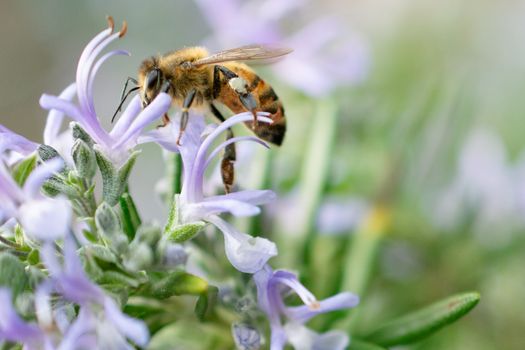
Honey bees are responsible for producing honey through regurgitation and evaporation of nectar, with a single colony producing up to 100 pounds of honey per year.
Honey Bee Biology and Honey Production
Honey bees are social insects that live in colonies and are known for their highly organized social structure. A single colony can contain up to 60,000 bees, with one queen bee, thousands of worker bees, and a few hundred drones. The worker bees are responsible for foraging for nectar, a sweet liquid secreted by plants, which is then converted into honey through regurgitation and evaporation.
On average, a single honey bee colony can produce up to 100 pounds of honey per year, depending on factors such as the strength of the colony, the availability of nectar-rich flowers, and the weather conditions. At Thai Chuan Fa Honey, we have observed that our strongest colonies can produce up to 150 pounds of honey per year.
Nectar Collection and Honey Production Process
The process of honey production begins with nectar collection. Honey bees visit flowers and collect nectar using their long, tube-shaped tongues called proboscis. The nectar is then stored in the bee’s honey stomach, which is specifically designed for this purpose. The bee then returns to the hive and regurgitates the nectar, sharing it with other bees in the hive.
The regurgitated nectar is then stored in cells within the honeycomb, which is made up of hexagonal wax cells. The water content of the nectar is then reduced through evaporation, thickening the nectar into honey. This process can take up to two weeks, depending on the temperature and humidity conditions.
Factors Affecting Honey Production
Several factors can affect honey production, including the strength of the colony, the availability of nectar-rich flowers, and the weather conditions. A strong colony with a large population of worker bees is more likely to produce a higher amount of honey. Additionally, the presence of nectar-rich flowers in the surrounding area can increase honey production, as the bees have a constant source of nectar to collect.
Weather conditions, such as temperature and rainfall, can also impact honey production. Extreme temperatures or drought can reduce the availability of nectar-rich flowers, while excessive rainfall can make it difficult for the bees to fly and collect nectar.
My Experience with Honey Production
I remember one year when our colony produced a record amount of honey – over 200 pounds per year. It was a great year for nectar-rich flowers, and our bees were able to collect and produce honey at an incredible rate. However, the following year was a different story. A severe drought hit our area, and the nectar-rich flowers were scarce. Our bees struggled to find enough nectar to produce honey, and our production was significantly lower than the previous year.
It was a valuable lesson in the importance of adapting to changing environmental conditions. We learned to be more careful with our beekeeping practices and to be prepared for unexpected weather patterns. We also started to diversify our beekeeping operations, planting a variety of nectar-rich flowers in our surrounding area to provide a constant source of nectar for our bees.
Beekeeping Equipment and Supplies
At Thai Chuan Fa Honey, we use a variety of beekeeping equipment and supplies to manage our colonies and produce high-quality honey. This includes beehives, protective clothing, smokers, and extractors. We also use high-quality bee food and supplements to ensure the health and well-being of our bees.
For more information on beekeeping equipment and supplies, please refer to our article อุปกรณับการปลูกและดูแลผึ้ง. We also recommend reading our article การปลูกและดูแลผึ้ง for tips and best practices on planting and caring for nectar-rich flowers.
Honey Harvesting and Extraction
Honey harvesting and extraction is a critical process in honey production. It involves removing the honeycomb from the beehive, extracting the honey from the comb, and bottling it for consumption. At Thai Chuan Fa Honey, we use a combination of traditional and modern methods to harvest and extract our honey.
We typically harvest our honey twice a year, in the spring and fall, when the nectar flow is at its peak. We use a combination of smoke and gentle vibrations to calm the bees and remove the honeycomb from the hive. The honeycomb is then extracted using a centrifugal extractor, which spins the comb to release the honey.
Quality Control and Packaging
At Thai Chuan Fa Honey, we take quality control and packaging very seriously. We ensure that our honey is of the highest quality, with a water content of less than 18% and a pollen count of over 100,000 grains per pound. We also package our honey in a variety of sizes, from small jars to large buckets, to meet the needs of our customers.
We use a combination of traditional and modern packaging methods, including glass jars, plastic containers, and beeswax wraps. We also offer custom labeling and packaging options for our wholesale customers.
Conclusion and Future Outlook
In conclusion, honey production is a complex process that involves the careful management of honey bee colonies, nectar-rich flowers, and beekeeping equipment and supplies. At Thai Chuan Fa Honey, we are committed to producing high-quality honey using traditional and modern methods. We believe that our attention to detail, commitment to quality, and dedication to sustainability set us apart from other honey producers.
We look forward to continuing to produce high-quality honey for our customers and to expanding our operations to meet the growing demand for natural and sustainable food products. For more information on our products and services, please visit our website or contact us directly.
This article does not replace professional medical advice.
Frequently Asked Questions
What is the average amount of honey produced by a single colony?
The average amount of honey produced by a single colony can range from 60-100 pounds per year, depending on factors such as the strength of the colony, the availability of nectar-rich flowers, and the weather conditions.
How often is honey harvested?
Honey is typically harvested twice a year, in the spring and fall, when the nectar flow is at its peak.
What is the water content of high-quality honey?
High-quality honey should have a water content of less than 18%.